

CES official day two!
CES 2026 isn’t over until Friday, and we’re here in the thick of it. This is the part of the show when a lot of the news is out of the way and folks spend their time taking meetings, hopefully making deals, and scouting new tech. We do the same thing (minus the making deals part).
There will be a little bit of news, of course. But much of that will come from what we find — and not a press conference.
To recap from yesterday, there were several keynotes, including from Siemens, Lenovo, and All-In podcast co-host Jason Calacanis, who interviewed Bob Sternfels, Global Managing Partner of McKinsey & Company, and Hemant Taneja, CEO of General Catalyst. There was also the Mobileye acquisition news — whew, $900 million! — a ton of reveals from Ring, and news from Commonwealth Fusion Systems that it has installed the first magnet in its Sparc fusion reactor.
Bee AI wearable adds new features after acquired by Amazon
Bee AI, a wearable company that was acquired by Amazon in 2025, said that it has added new features to its platform. The company, which continues to sell the wearable as a stand-alone product, said that it now connects with email and calendar, and when you tell the device about sending an email or scheduling a meeting, it automatically drafts an email or creates an event.

Users can now also take voice notes by pressing the button on the device and see them in the app. Plus, the app surfaces daily insights and patterns about how you are feeling if you use the wearable continuously.
Waymo is giving away door prizes

Image Credits:TechCrunch Waymo is back at CES 2026 and while I am told the booth is the same size as last year, it certainly seems bigger. Maybe it’s the giant rotating W that gives it that super-sized illusion. The booth includes displays of its Jaguar I-Pace and minivan-style Zeekr robotaxi as well as the standard explanatory spots within the booth. But this year there is a little something extra: door prizes.
Attendees can swipe their badge, press a big button, and out drops a Waymo pin. There is a special pin, pictured above, in the mix. And if you get it, well, you get an extra-special piece of Waymo swag, I’m told. The other three have cute sayings like “chill commute,” “backseat driver,” and “passenger princess.”

If the live blog is too swift, we’ve got you covered
We’ll be updating this post with some more of the big picture reveals and announcements from CES a few times throughout this week, so if you’re looking for something to bookmark and check in on for a TL;DR at the end of each day, look no further.
Jason Calacanis will pay you $25,000 if you can find him an authentic Theranos device
On Tuesday, at CES, All-In podcast host and investor Jason Calacanis, along with McKinsey’s Bob Sternfels and General Catalyst’s Hemant Taneja, discussed the impact of AI on the workforce. As the three talked, I zoned out a little, if I’m being honest (it’s after hours here on the East Coast).
Then Calacanis pulled out a box of outdated gadgets for show-and-tell. He grabbed my attention back when he showed off his miniature replica of a Theranos device — it looked like the miniLab, a product that disgraced founder Elizabeth Holmes unveiled in 2016 as a last-ditch effort to convince the world that her technology worked (it didn’t).

Image Credits:TechCrunch (screenshot) “If anybody can get me this, I’ll pay $10,000 or maybe $25,000,” Calacanis said, holding up his replica.
Theranos never actually sold its medical devices to everyday consumers, so Calacanis may be out of luck — but Holmes did demo the technology at a conference once, so there’s gotta be a miniLab somewhere? I can’t match Calacanis’ offer, but hey, I’ll throw in an extra $20 bill to sweeten the deal. Happy hunting!
Bloomin8 has a new take on e-ink frames
The Bloomin8 E‑ink Canvas, which is launching in a new smaller size at CES 2026, is an ultra-low-power e-ink display that you can set to show your own photos (including from Google Photos) or other art of your choosing.

Image Credits:Sarah Perez Similar to products like Aura, the e-ink offers paper-like visuals, but it doesn’t have a backlight or glow. As a result, the device is cordless, offering one to three years of battery life, instead of just weeks. Plus, with the companion app, you can use AI to generate imagery for your frames, schedule when the photos change, and more.

Image Credits:Sarah Perez The company’s Kickstarter was in March and had over 2,000 backers, with the devices shipping before Christmas 2025. Currently, the frames come in 13.3″ and 28.5″ but a smaller 10″ frame is soon launching for a sub-$200 price point.
Nosh is your new AI robot chef
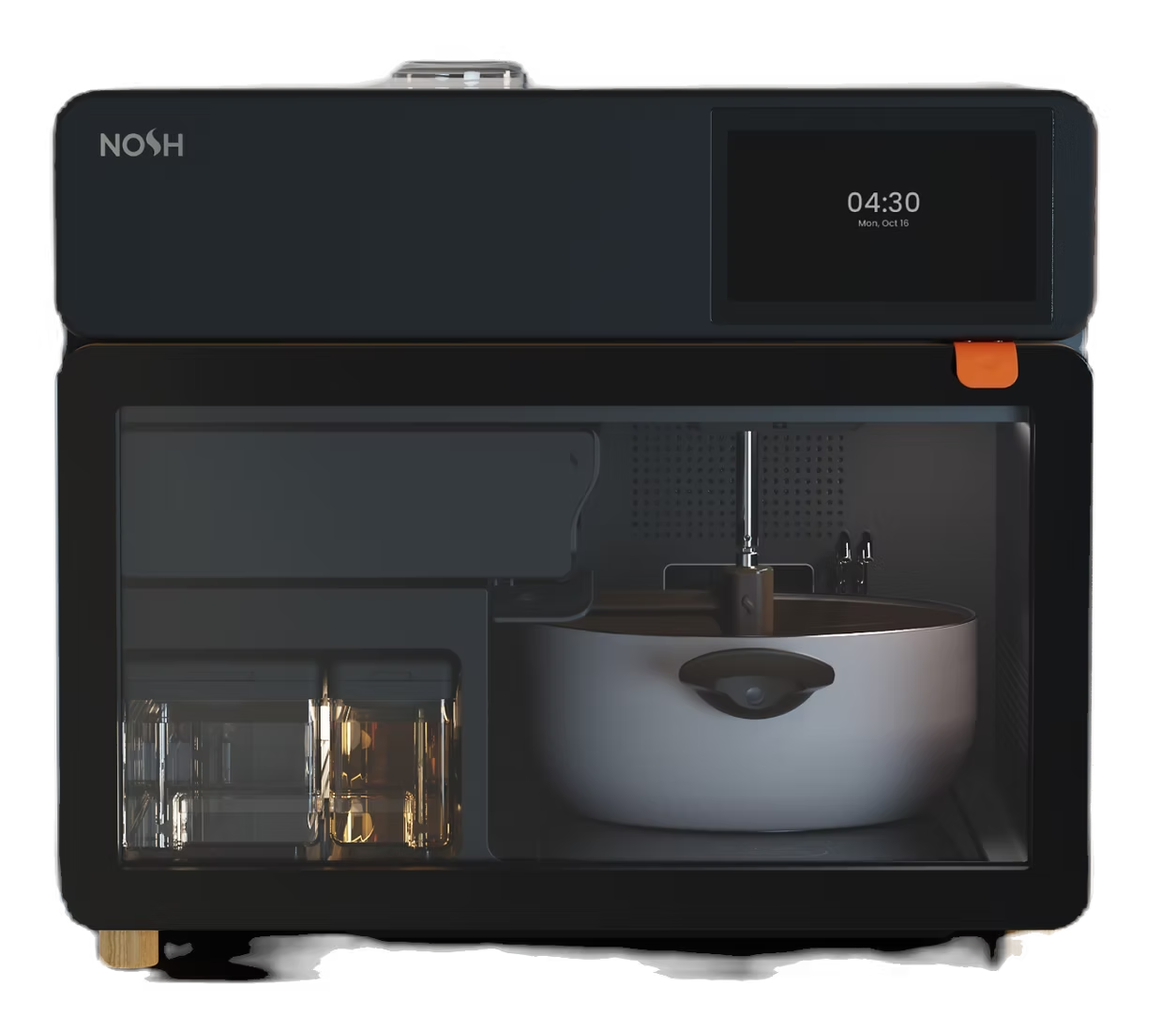
Image Credits:Nosh Nosh’s promise is that you load the ingredients and it will do the rest. Obviously, not every type of dish can be cooked by a robot in your kitchen, but the company says that it ships with over 500 recipes to choose from. The ingredients can be prepped in advance and stored in the ingredient tray in your fridge, then inserted into the device when ready to use.
A collection of spice containers inserts into the top, and there are containers for water and oil. When you choose a recipe to cook, the app tells you what ingredients go into what tray, allowing you to prep one time for the days of cooking ahead of you.
Image Credits:Sarah Perez The device will also customize its cooking to your dietary needs — for example, low sodium or less spicy. Forty-five minutes later, you have a single pot meal ready. The device takes up a fair bit of counter space, at 16 inches high and about 22 inches wide. The device is going live on Kickstarter on February 1 with a $25 buy-in and a price for early backers of $1,200. The MSRP will be $2,000. The company expects to ship 60 days after launch.
Nodi’s device connects kids when they’re too young for a smartphone

Image Credits:Nodi Nodi’s handheld technology is designed for kids who aren’t quite ready for a smartphone but want to talk to (approved) friends and family and listen to music. The small device lets parents configure which songs or playlists their kids can stream from Spotify, and it can send and receive voice messages with parent-approved contacts.

Image Credits:Sarah Perez The device will come in Wi-Fi ($149) and Wi-Fi plus LTE versions ($179) and lasts a few days per charge. The German-based company is now bringing its tech to the U.S. this summer. The company has $1.3 million in funding from Adjacent.
Mobileye is in the humanoid robots business now
Mobileye co-founder and president Amnon Shashua said Tuesday at CES 2026 that he is taking the company, known for its automotive chips, into its next phase. He’s calling it Mobileye 3.0 and for Shashua that means robots.
Specifically, Mobileye is planning to pay $900 million for Mentee Robotics, a humanoid robot startup co-founded by Shashua.
If that feels circular, you’re not wrong.
iPolish lets you change your nail color on the fly
Shut up and take my money. iPolish is at CES demo’ing its innovative nail technology that allows you to change your nail color at any time using its proprietary, patented technology, which includes a set of press-on nails and a small device used to change their colors. Over 400 nail colors are available to choose from via the companion app.

Image Credits:Sarah Perez The tech has been in development for over a decade, but the nails are only now coming to consumers. Founder Troy Fohrman says the technology that makes this work is a new class of polymers called electrophoretic nanopolymers — the iPolish team invented a new variant of this and now has 23 patents on the tech. The seven-person company formed in 2023, and preorders launched this week. The kit is only $95 with replacement nail packs at $6.50.
iPolish is backed by seed funding, after earlier self-funding. The goal is to ship the tech to customers starting in June. Eventually, the company aims to bring the tech to other makeup as well.
As per usual, the CES showroom floor belongs to the bots
It’s robots galore on the showroom floor. There are boxing robots, dancing robots, a robot that purportedly makes ice cream, and a Marty Supreme-esque robot that plays Ping-Pong. The latter is currently losing to its human competitor but, you know, it’s still playing Ping-Pong — so that’s pretty impressive.
The Ping-Pong player comes from Sharpa, whose primary product is a robotic hand, while some of the bots with the best dance moves have come from Unitree, which sells a number of quadruped robots.
Qiyang Zhang, the business development manager for Sharpa, told me that the full-bodied robot was rolled out for CES to demonstrate the robotic hand’s dexterity. Sharpa mostly sells its hand product to universities for research purposes, Zhang said.
Intel to launch handheld gaming platform and dedicated chip
Intel plans to challenge AMD’s handheld gaming prowess with a new gaming platform and chip dedicated to the devices.
The semiconductor company announced it was launching a platform, including software and hardware, for this slice of the gaming market, on Monday. Intel said it would have more to share later this year but confirmed to TechCrunch that this platform would include a dedicated chip.
This platform would be based off the Intel Core Ultra Series 3 Processor, known as Panther Lake, which made its formal debut at CES.
CES 2026: Follow live for the best, weirdest, most interesting tech as this robot and AI-heavy event wraps up
CES 2026, the annual consumer tech conference held in Las Vegas, is here. And lucky for you, we have TechCrunch editors and reporters on the ground to cover the news, scout out the interesting, weird, and relevant (and some not so relevant) tech, and of course the people working on it. AI has been at the center of most of the action, whether it’s Nvidia and AMD’s announcements or Amazon and Google’s push for its use in the physical world. Follow our live updates as we share all the reveals and new hardware as it happens.






May 27
Athens, Greece
StrictlyVC Athens is up next. Hear unfiltered insights straight from Europe’s tech leaders and connect with the people shaping what’s ahead. Lock in your spot before it’s gone.
